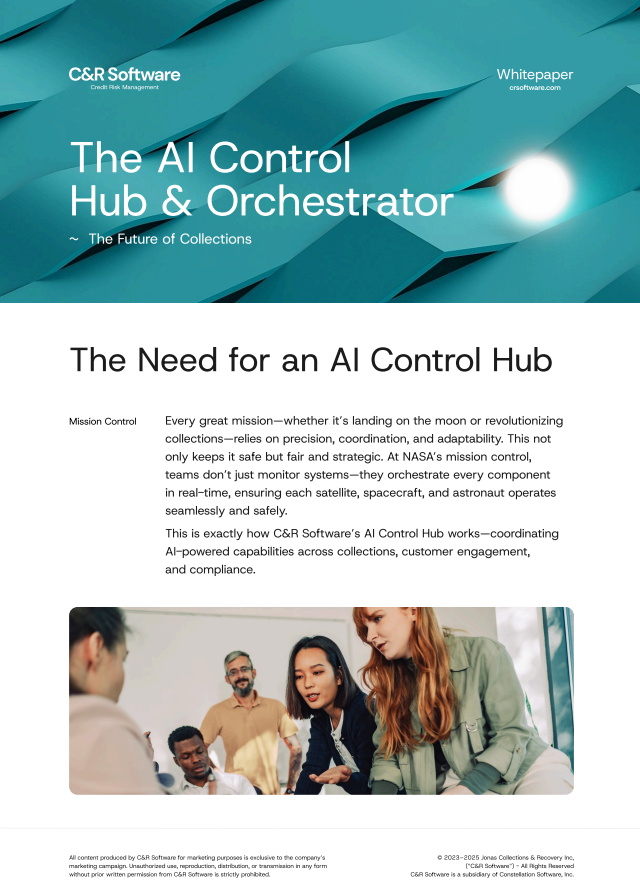
Collections teams are adding AI debt collection software faster than they can govern them. But when these tools operate in isolation, they can work against each other. A risk model recommends escalation while a decisioning tool recommends leniency. A hardship signal captured in one system never reaches the chatbot handling the same customer's next call.
This guide explains why collections needs a central AI Control Hub, modeled on the same orchestration principle that keeps a space mission's systems aligned, and what this architecture actually requires.
What's inside
- The five risks of deploying AI without centralized orchestration, including conflicting model recommendations and untracked, unauditable decisions
- The four pillars that separate a true AI Control Hub from a reactive patchwork of point to point integrations: integration, intelligence, governance, and adaptability
- How AI "satellite" capabilities, including conversational agents, predictive risk scoring, automated QA, and dynamic hardship assessment, should function as a coordinated network rather than standalone tools
- The AI Execution Framework underneath orchestration: decision engine, integration layer, workflow orchestration, data processing, and audit and governance
- Why cross system coordination matters most in hardship moments, when a payment plan, outreach cadence, and agent priority all need to update at once
- How to keep human judgment central to AI driven collections, even as orchestration increases automation